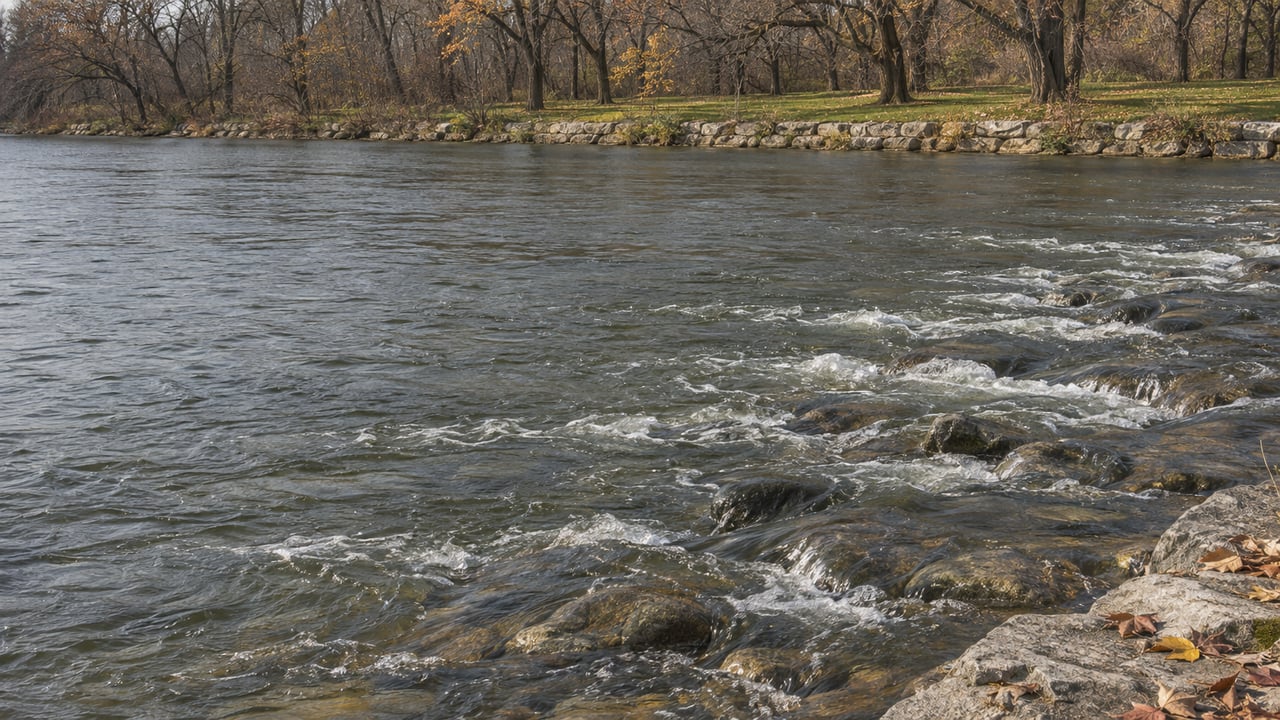
Stand on the Blue Bridge and look downstream. MLive described the scene in September: south of the bridge, "water rushes over newly placed boulders, churning and crashing through the restored channel." Two months later, that stretch has company. One of the four low-head dams is fully gone. A second is partly dug out. Boulder features run from Pearl Street to Fulton Street.
That matters for the next several months because the work is seasonal. In-river construction on the Grand River Restoration runs roughly July through November, stops for the winter and picks back up in 2027. As of October 28, the City's contractor, Taplin Group, was winding down its first season, and the Grand River Network's progress report called the work "swift, smooth and ahead of schedule." The river you walk past between now and next summer is a cross-section of the project. One stretch already behaves the way the whole reach is designed to, and the unfinished part is still in plain view.
What one season put in the water
The City numbers the dams one through four from Pearl Street, moving upstream. Here is where each piece stands at the season's end, based on the October progress report and the City's Lower Reach project page.
| Piece of the project | Status heading into winter |
|---|---|
| Dam 2 | Fully removed as of late October 2026 |
| Dam 1 | Removal started in September 2026, ahead of plan. Part of the west end is excavated |
| Remaining low-head dams | Removal expected in the second season, summer 2027 |
| Boulder drop structures | Installed between Dams 1 and 2 and running across the full width of the river |
| Habitat boulders | Placed across the Lower Reach, visible south of the Blue Bridge and between Dams 1 and 2 |
| J-hooks | All three installed between Pearl Street and Fulton Street |
Each feature does a different job. The boulder drops span the river and work "like a natural fish ladder" at higher velocity, and the progress report credits them with notable changes to how the river looks and sounds. The J-hooks are arched boulder structures that slow the current and create eddies, which the project says makes access better and safer. The habitat boulders give native species more varied places to live. Every boulder in the Lower Reach comes from Michigan's Upper or Lower Peninsula.
The finished design covers 2,887 feet of channel and 30 acres of river corridor. Grand Riverfront counts more than 125 scattered boulders in the full plan. The stretch running now is the first working sample of that larger layout.
Why Dam 1 sits half-dug all winter
Crews weren't supposed to touch Dam 1 until the second year. They started on it in September, and only a portion of its west end came out before the season wound down. The rest will pick back up next season.
The calendar is set by the river, and the City can't move it. State permits kept equipment out of the water until July 1. Per Grand Riverfront, the timing keeps water low at the Sixth Street Dam so invasive sea lamprey stay blocked while work goes on. The City's July 1 announcement said the start date also protects fish spawning periods. That leaves a fixed window of about five months a year. Getting into Dam 1 early used part of this year's window on work that would otherwise have waited for 2027.
The early start is also why the river now has a visible seam. Below the Blue Bridge, the boulder drops run fast and loud. At Dam 1, one partly excavated end shows exactly where crews stopped.
Where to watch from this winter
The City's Parks and Recreation Department pointed people to the Blue Bridge, Gillett Bridge and nearby downtown walkways to watch the river change week by week, MLive reported. Those spots line up with the features installed this season:
- The Blue Bridge. This is the closest view of the new rapids. The boulder drops and habitat boulders sit just south of the bridge.
- Lacks Park. MLive named it alongside the Blue Bridge as a place to see and hear the change up close.
- The Grand Rapids Public Museum riverfront. The first J-hooks went in near the new museum riverfront in late summer, and a blue heron locally called Bennett has become a regular there.
- Gillett Bridge. It stays open for the length of the project, and it overlooks the staging area.
Ah-Nab-Awen Park closed in May to serve as the main staging ground, and the City says it stays closed for the whole project. Before getting on the water or close to the construction zone, check current conditions on the City's Lower Reach page and follow any notices posted on site.
If you're downtown for the 105th Grand Rapids Santa Parade on Saturday, November 21, the tree-lighting events at Rosa Parks Circle run from 5 to 7:30 p.m., WOOD TV8 reported. The river viewing spots above are downtown too, so one trip can cover both.
What came out of the riverbed
The first season also pulled up pieces of the old river. Crews removing Dam 2 dug up a hand-rolled steel pipe believed to date to at least the 1920s, and what's left of it went to the Grand Rapids Public Museum. Earlier in the summer, crews clearing part of a downtown dam lifted out a slab of limestone with circles and channels worn into its face. Those are flow paths cut by fast water that stopped running decades ago. Grand Riverfront called it "the closest thing we have to a photograph of the rapids that named this city."
Before the work started, divers moved about 80 mussels and 1,600 fish this year, including endangered freshwater mussel species. The project names lake sturgeon, river redhorse and snuffbox mussel among the species it's meant to help.
The fast pace this year stands out against how long the project took to get started. The effort took public shape in 2009. In 2023, state regulators rejected the proposed design over how much material would go into the riverbed. A smaller revised plan won state approval in late 2024. On the morning equipment entered the river, Grand Rapids Whitewater executive director Matt Chapman called it the result of "an 18-year commitment from multiple community partners," according to the City's announcement.
What summer 2027 adds, and what waits longer
The City lists the second construction season as anticipated for summer 2027, with removal of the remaining low-head dams. The City expects the Lower Reach to be finished by the end of 2027, weather and river conditions permitting. Project manager Mike Staal has described the finished stretch as long and gradual, natural enough that fish won't notice the difference, Grand Riverfront reported.
Upstream, the Sixth Street Dam is a separate project on a slower schedule. The Upper Reach focuses on sea lamprey control and fish passage. The U.S. Army Corps of Engineers is studying options that include removing the dam and building a replacement lamprey barrier. Its posted schedule forecasts a draft environmental impact statement in spring or summer 2027, a final version in winter 2028 and a decision in 2028. According to Grand Rapids Whitewater, the Lower Reach work doesn't affect the Fish Ladder at Sixth Street Park. Changes to the ladder are possible only as part of the Upper Reach project.
The river is one of the clearest signs of how fast downtown Grand Rapids is changing. If you own a home in the city and want to know how today's market values it, Glover Agency can give you a pricing read built on current local sales. See Your Market Value.